AI Survival Strategies
Essential strategies for businesses to not just survive, but thrive in the rapidly evolving AI-driven economy.
Strategic framework for surviving and thriving in the AI era
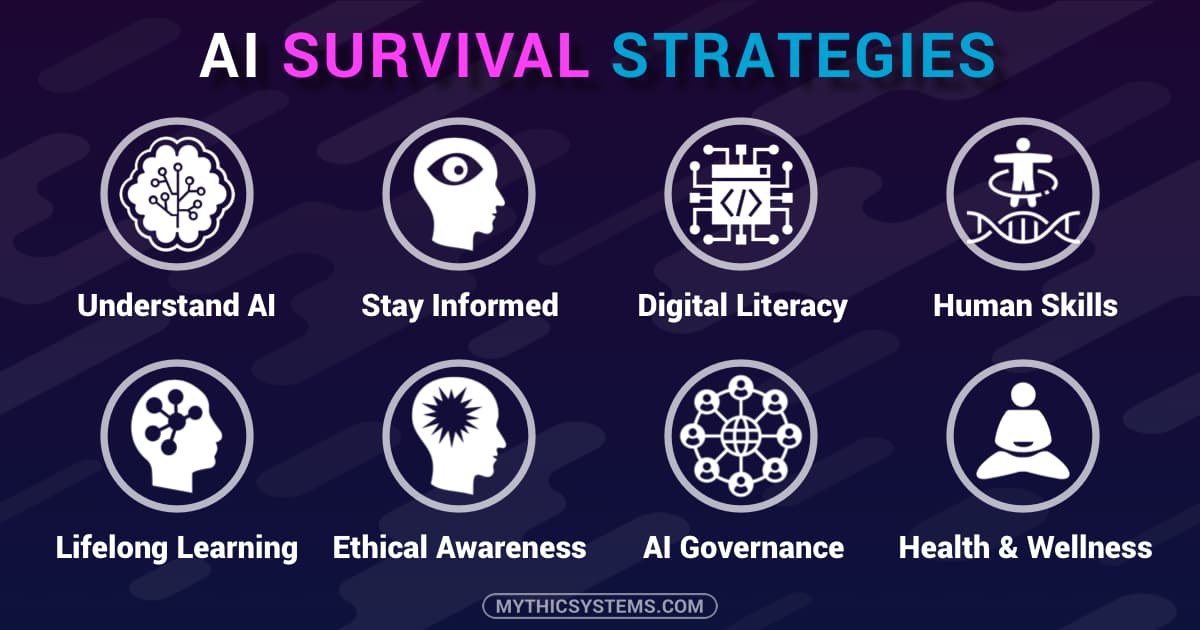
Three-Pillar Survival Framework
A comprehensive approach combining defensive, adaptive, and offensive strategies
Defensive Strategies
Protect your business from AI disruption and competitive threats
Adaptive Strategies
Build organizational agility to respond quickly to AI-driven changes
Offensive Strategies
Leverage AI to create competitive advantages and new opportunities
The AI Survival Imperative
- • AI disruption is accelerating across all industries and business functions
- • Companies that fail to adapt risk becoming obsolete within 5-10 years
- • Survival requires both defensive protection and offensive innovation
- • The window for strategic response is narrowing rapidly
- • Success demands organizational transformation, not just technology adoption
Understanding the AI Threat Landscape
The AI revolution presents unprecedented challenges to established businesses. Unlike previous technological shifts, AI's impact is both broad and deep, affecting every aspect of business operations from customer service to strategic planning.
The speed of AI advancement means that competitive advantages can be created or destroyed in months rather than years. Organizations must develop new capabilities for rapid adaptation while maintaining operational excellence in their core business.
Defensive Strategies: Protecting Your Core
Risk Assessment and Monitoring
Continuously assess how AI developments could threaten your business model, competitive position, and operational capabilities.
- • Regular competitive intelligence gathering
- • Technology trend monitoring and analysis
- • Vulnerability assessment of core business processes
- • Early warning systems for market disruption
Skill Development and Workforce Preparation
Invest in developing AI literacy and complementary human skills that will remain valuable in an AI-augmented workplace.
- • AI literacy training for all employees
- • Development of uniquely human skills (creativity, empathy, complex reasoning)
- • Cross-functional skill development
- • Leadership development for AI-driven organizations
Adaptive Strategies: Building Organizational Agility
Survival in the AI era requires unprecedented organizational agility. Companies must be able to pivot quickly, experiment rapidly, and learn continuously from both successes and failures.
Building Adaptive Capacity
Organizational Structure
- • Flatter, more flexible hierarchies
- • Cross-functional teams and projects
- • Rapid decision-making processes
- • Decentralized innovation capabilities
Cultural Transformation
- • Embrace of experimentation and failure
- • Continuous learning mindset
- • Data-driven decision making
- • Openness to external partnerships
Offensive Strategies: Creating Competitive Advantage
The most successful organizations won't just defend against AI disruption—they'll use AI to create new competitive advantages and market opportunities.
This requires bold investment in AI capabilities, strategic partnerships, and innovative business models that leverage AI's unique strengths.
Implementation Roadmap
Phase 1: Assessment (Months 1-3)
Conduct comprehensive assessment of AI threats and opportunities specific to your industry and business model.
- • Competitive landscape analysis
- • Internal capability assessment
- • Risk and opportunity identification
- • Strategic priority setting
Phase 2: Foundation Building (Months 4-12)
Build the foundational capabilities needed for AI survival and success.
- • Workforce development and training
- • Technology infrastructure upgrades
- • Process optimization and automation
- • Cultural transformation initiatives
Phase 3: Strategic Implementation (Months 12+)
Execute offensive strategies to create competitive advantages and new market opportunities.
- • AI-powered product and service innovation
- • Strategic partnerships and acquisitions
- • Market expansion and disruption
- • Continuous optimization and scaling
External Resources

Related Guides
Continue building your AI survival strategy with these related resources
AI Integration Strategies
Strategic approaches to integrating AI into your business operations
AI Transforms Businesses
Understanding how AI is fundamentally changing business operations and strategy
Building Ethical AI Businesses
Learn how to build AI businesses that prioritize human values and responsible innovation
Join 1000+ leaders transforming with AI
Get strategic insights, tools, and frameworks delivered to your inbox. Our AI Guide newsletter informs, involves, and inspires leaders navigating the AI era.
Ready to Build Your AI Survival Strategy?
Don't wait for disruption to find you. Let's create a proactive strategy to help your business thrive in the AI era.